Category Archives: Catalonia

Are the Brits the most racist Catalans?

Most of the genuine Catalan people I know ( real ones – not the ones who are called Jordi Gárcia Sánchez et al)”

You won’t hear many Catalans spouting this kind of crap (though I know ‘charnego’ still gets chucked about sometimes by the knuckle-draggers and mouth-breathers). So why would a dodgy English blogger from a two-donkey village outside Barcelona* try to get away with it?

Note also the smooth practice of closing comments on a post when you’ve been proven wrong continues as if it’ll never go out of fashion.

__
*No relation.

Less than 30% turnout in today’s Catalan independence ‘consultations’

TV3 is reporting that of the 700,000 people eligible to vote in today’s referendum/consultations, 200,000 voted. If that number is correct, the turnout stands at just under 30%.

What does this mean for Catalonia? There are several points to take into consideration (which affect any interpretation of events in various ways):

  • The consultations were non-official and therefore certainly not taken as seriously as an official referendum would be. This means that the approx. 30% who did take part probably come from more politicised parts of Catalan society. I suspect that pro-independence elements will have voted more strongly (based on the fact that only the pro-independence movements seemed to be drumming up any support for the ballots). The other 70% of the population would likely include far more anti-independence voters than today’s result will indicate.
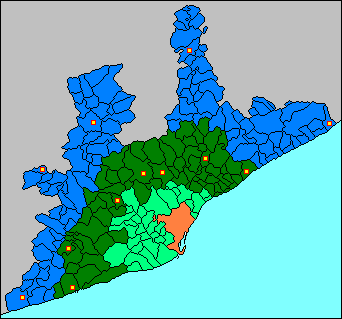
  • The consultations were carried out in largely rural towns and villages, which traditionally demonstrate a much stronger level of support for Catalan independence. Barcelona and its suburbs, along with Tarragona and environs have large numbers of voters, including many with a more Spain-centric (and sometimes right-wing nationalist) point of view than will likely be seen in today’s results.
  • The consultations seemed to go without mention at all on TVE 1 this morning. For an official referendum, we can imagine that their coverage would have been different.
  • The consultations allowed votes from anyone over 16 and registered in the municipality concerned. An official referendum would likely follow Spanish/European electoral law and limit the electorate to Spanish citizens aged over 18. I’ll add that I’d like it if 16-18 year olds, and non-Spanish citizens were allowed to vote in elections. But they’re not.
  • The consultations have happened at a time when general support for Spanish PM Zapatero is very low (as was possibly intended). A PM from the Partido Popular would likely increase the pro-independence vote. A more popular Zapatero (or alternative) might well reduce it.

It remains to be seen what effect these consultations in the form of a referendum will have on Catalonia’s political future. My bet is that whatever the result, ERC, CUP and the CdC will claim it as a vote in favour for an official referendum within the next two or three years.

Barcelona, if it ever manages to hold a similar consultation, will always be the decider.

13D: Some of Catalonia votes for independence tomorrow

This weekend, 700,000 people in Catalonia are eligible to vote in the region’s first ever referendum on independence from Spain.

Or at least, that’s how the BBC has it. Tomorrow will be interesting because the turnout will give everyone an idea of how far CUP, ERC and even CiU can run with independence as a vote winner. But Barcelona and the more ‘Spanish’ suburbs (like Cerdanyola) aren’t taking part. As I’ve pointed out elsewhere: we all know that if it were up to Vic, Catalonia would have declared independence years ago.

I’ll be watching tomorrow’s results with some interest. But I’d rather they had a proper vote, and we could all be done with it.

Spanish corruption news round-up

I’ve been off work for a few days due to a wicked cold, which has left me thinking that probably the last thing I need to do is spend more time in front of my computer. But all the same, there are a couple of stories developing in Spain which deserve something of a recap.

Firstly, Gürtel. This case of corruption in the Valencian PP has moved on quite a lot since the courts ruled that it was unlawful to ‘archive’ the case. The PP itself has moved from dogged support for anyone and everyone connected with the party to a few pre-emptive and yet also belated amputations. Top of the list is Ricardo Costa, general secretary of the Valencian PP. President of the Comunitat Valenciana Fracisco Camps seems to have had his hand forced by PP head office and has announced that Costa will be out in a few days, all the while noting that he trusts and backs him implicitly. This is the first major head to roll in the PP but it likely won’t be the last. Esperanza Aguirre, president of the Comunidad de Madrid has also forced the exclusion of three regional PP names, Alberto López Viejo, Alfonso Bosch Tejedor and Benjamín Martín Vasco – all linked with the Gürtel case.

Aguirre, suave political operator that she is, seems to be using this corruption case to make another push for control of the party. It remains to be seen how successful she is in this enterprise… but the idea of her leading the national party is slowly becoming a terrifyingly real possibility.

I wouldn’t want to incur the wrath of Trevor by failing to mention the Palau de la Música Catalana case, here in Barcelona. This story, though nowhere near as politically damaging as the Gürtel case, is still serious enough to warrant a proper full-length blog post some time in the future. Essentially, the PMC case is a classic story of misuse of public funds (aka ‘stealing a shit load of cash’). Boss of the Orfeó Catalan, Felix Millet, has more-or-less admitted that more than €3m of Palau funds went missing under his stewardship. He seems to have spent the money on himself (and his business partner Jordi Montull). It seems that among other things, the pair used some of the money to buy a building which they then sold on at a €1.5m profit.

The larger crime in the PMC case is that the bill for refurbishing the Palau a few years back was a massive €22m, even though it actually cost less than half that. So Millet seems to be willing to admit the ‘smaller’ crime in the hope that everyone will just forget about the other €13m that he nicked. Sadly, this could just happen: this case should have been in the courts years ago but for some reason only seems to have made it there now.

The political sides of this story are twofold: firstly, Millet is a big player in Barcelona’s political-cultural axis. The position of head of the Orfeó/Palau is extremely prestigious and Millet also served on the board of FC Barcelona and was a recipient of the Generalitat’s St Jordi cross. All that, and he seems to have donated about €500,000 to the Fundació Trías Fargas, a politico-cultural organisation which is effectively a part of the CDC, which itself is a constituent party in CiU.

The second controversy (and arguably by far the more important one) is that the courts in Barcelona received notice of presumed corruption, lots of €500 notes and various irregularities in the Palau, five years ago. It seems that they’ve done very little to prosecute the case since then, until now. Why? I suppose that would be the corruption.
thebadPoll: Where to live in Barcelona?

RmdBcn

Gemma and I are beginning the process of looking for a new house. Our awesome little flat in Cerdanyola del Vallès was perfect as a starting point for our life together here but 7 years on, it’s not getting any bigger. We’re looking in Cerdanyola, because we like the area where we live. But we’re also going to look at places in other parts of the metropolitan zone. This thebadPoll is really very simple: where would you choose to live in BCN if you could choose right now? Do you like the narrow streets of the Gòtic, or do you prefer the seaside charm of Vilanova i la Geltrù?

The list of options is not exhaustive, so feel free to recommend a place if you really think it needs a special mention.

As usual, you can vote on the right >> … but it’s your comments I’m hungry for.

Joan Laporta: candidate for independence?

The president of FC Barcelona, Joan Laporta, has been ‘invited’ to head up the electoral list of a Catalan separatist party. Reagrupament, a group that split from Esquerra Republicana (essentially on the grounds that the ERC leadership were allegedly losing their direction by participating in a coalition with the Madrid-controlled PSC), asked the Barça chief to be their first candidate in next year’s Generalitat election.

Laporta will end his Barça presidency in June, and until then he appears unlikely to announce any plan for his future career. That career, according to many commentators, will consist of a long-planned Catalanista political thrust, a rumour backed up by Laporta’s presence at the alternative celebrations for the Diada, last September 11th.

If it does happen, it will hardly be a surprise. Laporta has overseen the completion of the Catalanisation process at FC Barcelona, a process which begins with the club’s own constitution. If he does accept the Reagrupament job, he’ll likely prove to be a smooth and cunning opponent in the election. Is it just me, or is there a lot more independentist stuff bubbling on the stove at the moment?

WordPress is dicking me about with images at the moment… but anyway, here’s a nice pic of Laporta looking extremely comfortable with PSOE stooge, Montilla

laporta-montilla-1

Barcelona sex mayhem – stories from Sunday night

Now I don’t know how late Giles Tremlett filed this story about Barcelona. But the Guardian has it timestamped at 1938 Madrid time, which is certainly late enough to have come after a very hearty lunch indeed. One clue suggesting that this is the case comes in the form of the article’s shortness. Tremlett isn’t the most wordy of reporters but all the same…

Another oddity is Tremlett’s insistence that “Although Las Ramblas has always attracted prostitutes, they used to occupy a small area near the port”, which is, as a local travelling tinker muttered to me, “a complete load of bollocks”. I’m not sure when this golden age of non bollock grabbing Rambline strolling is supposed to have occurred but it was certainly not very recently. Barcelona has always been packed to the rafters with ladies and gentlemen of the night (and plenty of lady gentlemen too). Indeed, it’d be hard to walk down a single street in the city without passing some brothel or other (even if you don’t realise it).

What this whole story really represents is the latest development in a late-summer-nothing-to-publish episode, where El País shocked our sensibilities (and had us checking again and again) with some pictures of a long-haired tourist making the beast with one back with a prostitute round the back of an overpriced market. Noted local newspaper, 20 Minutos (oh, yes I did!) interviewed various pillars of the community the other day, asking them whether they thought that Les Rambles has a major problem with prostitution. General opinion: it’s a hell of a lot better now than it used to be.

My feelings: Mexican sombreros and €7 a beer are far more offensive and nearly as exploitative.

Arenys de Munt independence ‘consultation’ banned

A non-binding public consultation on Catalan independence, which was due to take place in Arenys de Munt this September 13th has been banned. A judge in Barcelona accepted the Madrid government’s argument that only they have the authority to operate public consultations. The court also ruled that a town may not have a consultation that includes issues that are not wholly municipal, and that the Ajuntament (town hall) was too involved in the event, which is also illegal. The pretend referendum is being organised by MAPA, the Arenys group for Catalan self-determination (not by the town hall).

The vote gained widespread attention because fascist throwbacks, the Falange de las JONS announced a plan to protest against any movement for Catalan independence. In Arenys de Munt. On the 13th. Because that wouldn’t be remotely confrontational.

Anyway, what we see here is further use of the PSOE’s favourite tactic for disallowing democratic processes it feels it cannot control. The government typically waits until around a week before the event in question and then deploys its legal arguments, knowing that an appeal would be costly and would have to be done quickly. They did the same thing with their attempted criminalisation of Iniciativa Internacionalista and they’ve dealt with Basque political parties in a similar way.

As one commentator has asked: why all this effort to not hear what people want?

Organisers of the consultation have put a brave face on it: they reckon that a postal vote is still permitted. This story ain’t over yet.

This is war! War makes madness! This is madness?

This billboard is on my walk from the bus to work. It’s advertising the ‘This is war! Robert Capa at work’ photographic exhibition which has come to Barcelona after a successful stint in London. The image used is, of course, Loyalist Militiaman at the Moment of Death – a fine photograph which most experts consider to have been posed (not that this makes any real difference: all images are created, one way or  another, and this is a particularly good image).

Attached to the billboard is an interesting statement from persons unknown, pointing out that Capa’s great work was staged, and then continuing for lines and lines and lines without really saying anything that makes sense. Is this madness?

One other thing worth noting: hampones is a synonym of ladrones, I’m told. It’s a new one on me.

capa2 capa1