Tag Archives: Spain

You call this an olive?

Some people in Spain take their olives very seriously indeed. Like this chap from Gijón who received a dish of olives as a tapa to accompany the drink he’d ordered.

Upon trying the olives, he apparently ‘went mental’, complained about the olives, insulted the bar owner and proceeded to cause €500 worth of damage to the joint, throwing tables and chairs at passing vehicles, and smashing glasses and bottles.

Perfectly reasonable behaviour, you might well think. And I’d agree. What sort of disgraceful behaviour would make you totally flip out?

Dr. Coldlove, or: Why I learned to stop worrying and love the aircon

This post is related to my last, partly because it deals with my unpopular suggestions for dealing with common problems and partly because it involves mosquitoes (‘the devil’s moths’ as I call them*).

Last night, with an indoors temperature of 30º and level of humidity that a fan would not shift, only direct, we elected to put the air conditioning on all night. It was a simple enough decision. Gemma turned to me and said “I think we should put the a…” but by then, I’d already closed all the windows and found the remote control for our air-con unit. We continued to watch Star Trek: First Contact with the pleasant, and pleasantly guilty, feeling of cool air caressing our youthful skins. (Well, Gemma has a youthful skin; despite being YEARS younger than her, mine has developed the reddish hue and blood-vesseled texture of a Plymouthian living in Spain**).

We slept right through the night with barely a stir, except for when it got too cold. One of the many advantages of sleeping with the air conditioning on is the fact that it’s cooler when you want to sleep. Another advantage is that while you have the windows closed, all but the most ingenious mosquitoes are barred from entry to your boudoir. A disadvantage is that any cigarette smoke from the sitting room that wasn’t expelled before the airlock was sealed becomes your ‘smoke buddy’ for the night (though this probably helps some people maintain a minimal nicotine blood level and for that reason it should probably be counted as another advantage). There are no other real disadvantages… unless everyone does the same. Because that would cause massive amounts of carbon to be released into the atmosphere, by way of electricity generation.

So I ask you, people of Barcelona, Toulouse, Marrakesh, Los Angeles, Singapore, Perth (Australia, obviously) and Mumbai: tonight, switch your air conditioning off. I won’t, because I need it. But if you took some time to think about the future of the planet, you would.

__

* I refer to moths as ‘the devil’s butterflies’ and mosquitoes as ‘the devil’s moths’.

** I was born in Freedom Fields

*** Obviously the title could have been “Dr. Coldlove, or: How I learned to stop worrying and love the aircon” but I decided against it

Updated: Reports of electoral fraud in Spain

As mentioned in comments on my last post, there are reports today of numerous discrepancies in vote counting across Spain. Many of these incidents involve relatively small numbers of votes. But taken together, there are enough examples to plausibly suggest a widespread campaign against parties of the left, and those supporting independence for some of the ‘autonomous regions’ in Spain.

The story is being widely reported in the Catalan and Basque pro-independence media but has had few mentions in the mainstream Spanish press. The main party apparently affected by these discrepancies is Iniciativa Internacionalista (II-SP), which the Spanish government failed to have banned shortly before the elections. Zapatero’s government accused II-SP of being a front organisation for ETA but failed to present evidence supporting this claim to the courts. II-SP received a vote of support from Arnaldo Otegi, spokesman for the outlawed Basque party Batasuna days before the elections. PP leader, Mariano Rajoy named them “the ETA list”, while UPyD leader Rosa Díez declared that II-SP “is ETA”. Apparently taking the lead from the USA’s former right-wing government, neither party leader deigned to share their evidence with the voters they were appealing to.

The allegations fall into three groups: (a) the general feeling that the huge increase in blank and spoiled votes coincides a little too smoothly with II-SP and other parties faring more poorly than expected; (b) specific examples of localities reporting examples of discrepancies between town-hall and Spanish Ministry of Interior official figures; and (c) inexplicable displays of support for far-right parties in areas where they have never previously shown any support (normally at the expense of another party which did worse than expected).

It’s too late for me to scurry around collecting examples of the three groups now, but the comments pages of this Avui story list several (at least one of which, the Vilafranca del Penedès one, seems to have been ‘corrected’, though by which side, I can’t tell). Rab is sure that the way that these discrepancies affect specific parties suggests a fraud. I’ll wait and see what appears tomorrow before I make the same judgement.

UPDATE

OK this is getting silly.

María Teresa Fernández de la Vega (Spanish VP)’s constituency recorded no votes for the PSOE

Europe of the Peoples-Greens have denounced irregularities

II-SP officials removed from recounts

Numerous towns appear to have returned erroneous numbers, major Spanish press outlets stay silent

EU parliament election results in Catalonia

For coverage of Spain as a whole, take a look at Graeme’s posts here and here.

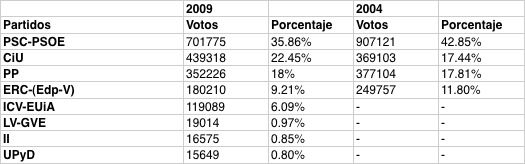
The results in Catalonia were a mixture of ‘more of the same’ and a disappointingly low turn out. The PSOE-PSC won again, albeit with a share of the vote that dropped from 42% to 35%. CiU were next, their share increasing 5 points to 22%. In fact, CiU were the only major party to see their actual number of votes rise in a worryingly low turnout of 37%. The PP gained a 1 point increase in their share of the vote, while ERC came fourth with a small drop in their share.

Interestingly, there were 72,681 spoiled or blank votes, which taken together constitute the 6th biggest constituency in the election, after IU-ICV who got 6% of the total vote. I’m told by a friend that there were also 6 times as many of these spoiled or blank votes than there were in the last EU parliament election.

Among the newer parties running this year, Iniciativa Internacionalista gained more votes than Rosa Diez’s UPyD – but both failed to get 1% of the vote here. Veritas and Esquerra Anticapitalista received 0.36% and 0.26% respectively.

The older style fascist parties look to have made some gains but their numbers are still so low that it’s hard to be too worried. The Falange Española de las JONS nearly tripled their number of votes… to a total of 1,575. The Falange Auténtica and Democracia Nacional also increased their number of votes, but the total number of people voting for far-right parties in Catalonia (no, I’m not including the PP), remains very low.

Table of results:

moz-screenshot-10

Full table available at El País.

Franco / Has only got one ball

…or apparently he did, anyway.

Yes, it seems that Spain’s fascist dictator lost a testicle when he was injured during a battle in 1916. Which was, curiously, the same year that Hitler is alleged to have lost one of his.

Could it be that the loss of a testicle in 1916 made an under-skilled military man predestined to become a vile monster?

Perhaps they should dig him out of his slave-built mausoleum in the Valle de los Caídos to check. They could knock that awful place down while they’re at it.

Another political party banned in Spain

Iniciativa Internacionalista, a new party formed for the EU elections, has been banned by the Spanish supreme court. The court judged that it is a reformed edition of Acción Nationalista Vasca and Batasuna. and therefore represents the political wing of separatist group ETA.

The party, which seems to have been standing accross Spain, describes itself as supporting ‘state socialism’, the protection of rights, an end to capitalism in Europe, independence for the Basque and Catalan countries, and has links with some internationalist/Trotskyite groups in Spain. The Spanish government, which retains the right to ban any political party it alleges is working to represent ETA at the ballot box, stated that it had received information from state security forces that various members of II have differing levels of contact with multiple far-let, violent and ‘terrorist’ groups in the Basque Country. Among those accused are the party’s leader, writer Alfonso Sastre [ES].

It should be clear to anyone that banning political parties is not the way to deal with problems in a democracy. Whether or not Spain is still deemed to be ’emergent’, it strikes me that this is not the measured action of a mature government. And now, the illegalisation of parties is beginning to affect polls in the other regions of Spain.

Ya Empezamos! Caja Castilla La Mancha ‘bailed out’

The Spanish government has moved to ‘bail out’ the first banking institution to fail in Spain during the current financial crisis.

In Spain, we have banks ‘bancos de credito’ and building societies ‘cajas de ahorros’, with the building societies being the most common place for Spaniards to keep their money. There are tons of building societies here, and the Caja Castilla La Mancha (CCM) isn’t the largest by a long way (I believe that this honour falls to La Caixa d’Estalvis i Pensions de Barcelona, ‘La Caixa’). In fact, CCM is apparently the newest of Spain’s building societies. All the same, news of troubles at CCM suggests that the building society system here, much touted as being safer than those in other European countries, isn’t quite as cast-iron as we’d been led to believe.

I bank with La Caixa (well, I have my salary paid there: I don’t get involved in anything more complex than having a credit card), and I will be damned annoyed if it appears that the Barcelona bank is in trouble too. The amount they charge me for basic services….

Let’s hope that this so-called bail out means that normal customers don’t end up losing any of their cash. But shouldn’t we be pushing for a full nationalisation of the banks? I feel a poll coming on.

European parliament votes against choice of language in schools

Despite being generally divided on the issue of multilingualism, the parliament apparently approved a PSOE-CiU-ICV-PNV-EA amendment that removed references to parents’ rights to choose the language in which their children are taught. Protecting the range of languages in some countries (like Spain) was described as ‘essential’.

So that’s the end of that debate, I imagine.

The Kosovo problem

It’s a lovely sunny day here in Cerdanyola del Vallès, so I’ll probably spend it doing some of my favourite things: installing Ubuntu ‘Jaunty’ Alpha 6 on my netbook, playing Empire Total War, writing performance reviews for my team at work… and reading about how Zapatero’s suffering with the ‘Kosovo problem’.

The problem, in case you didn’t know, is fairly simple: Spain refuses to recognise Kosovo as an independent state because this would signify acceptance that small nations may break away from supra-national states like Serbia or… Spain. You see where this is going, don’t you? Because of this tricky diplomatic choice, Spain has now announced that it will withdraw its armed forces from the NATO peacekeeping force which polices Kosovo. This has upset the United States, and effectively dissolves any credit Zapatero may have had with the new regime in Washington DC. The American response was an expression of “deep disappointment”, according to El País, with State Department spokesman Robert Wood saying that the US “neither understands nor agrees with” Spain’s move. Zapatero claims that Spain’s NATO allies were aware of the planned exit, but other sources suggest that all this came as something of a surprise.

So basically, Spain pulls out of the Balkan state in an attempt to prevent the ‘Balkanisation’ of Spain.

Personally, I’m not really that fussed about Spain losing some grace in Washington DC, or with NATO: neither the US government nor their SEO agency in Europe operate with anything like the moral clarity that I’d like to see. But many Spaniards do worry about these things… indeed, some bloggers used to spend nearly all their time monitoring Zapatero’s approval ratings in the Bush administration (a bit of a waste of time, that). The Partido ‘Popular’ have been quick to label this as ‘another disaster’ for the Socialist government, though typically they offer no alternative solution.

And that’s because the solution to the problem, for all the PP’s crowing, would be unthinkable for any Spanish government. The solution is simple: recognise Kosovo. It’ll have to happen eventually anyway, so why not get it done now and avoid all this hassle? To me, Zapatero seems to have reacted to the PP’s rhetoric about a ‘Balkanisation’ that almost certainly won’t happen. The reason it won’t happen is that there just isn’t enough public support for independence in the two most troublesome ‘nations’ within Spain: the Basque Country and Catalonia.

If referenda were held in 2012 in the Basque Country and Catalonia, I’m pretty sure that the Basques would vote in favour of staying part of Spain, and so would the Catalans (although the Catalan result would probably be closer). What Zapatero risks with this childish insistence on failing to recognise Kosovo’s independence is that people will start to take the concept of Spain’s constituent nations breaking away, seriously. The bolder (though obviously slightly more risky) move would be to recognise Kosovo and then say “referendum on Catalan independence? BRING IT ON!”.

That the Spanish state is so afraid of a referendum threatens to make it a self-fulfilling prophecy.
Arrests in Barcelona: Fraud or terrorism?

The other night, 13 men were arrested in the Raval district of Barcelona and in Valencia on suspicion of fraud. Apparently, they were running a criminal gang that forged passports and Spanish ID cards.

But on the Catalan news yesterday morning, they were already being described as ‘jihadists’ and ‘suspected terrorists’. Channel 4 news in the UK this evening picked up the story and added drug trafficking to the rap sheet (this appears to be a similar combination as that reported in Público)

Now, I’m finding it difficult to track down the warrant that was issued for these men’s arrests. If anyone could help me out with this, I’d be very grateful.

Interesting to note that some comments in El País theorise that the story was used to ‘bury’ the large increase in unemployment in Spain, a story that broke the same morning.