Category Archives: Catalonia

Pact for Catalan government made; 2014 referendum agreed

Govern de Catalunya

CiU and ERC have agreed the terms for forming a government in Catalonia. The major detail behind the agreement is that a referendum on Catalan independence ‘will be held in 2014’. The pact comes almost as late as it could – the government needs to be formed by next Monday to prevent new elections being held.

Also agreed on are at least 2 new taxes designed to prevent (or more likely, reduce) further cuts in public spending (updated info below). A tax on bank deposits (my understanding is that it’s not financial transactions that are being taxed, but people or firms putting money in the bank – so it sounds like a regressive tax at the moment, but a tax rather than cuts, all the same), and a tax on sweet fizzy drinks. Both taxes are being criticised by the Spanish government. Other taxes being considered are a restored inheritance tax and a tax on the nuclear power plants. Impressively, CiU’s “no alternative” mantra looks to have been a smokescreen for pushing through the cuts it wanted. Funny, that.

The agreement on the referendum isn’t quite as firm as the newspaper headlines are making it sound. It depends on the socio-political situation in 2014 and agreement between the two party leaders that it’s the right time to go ahead. So there are plenty of opportunities for various CiU bosses to derail the process between now and then. It seems that the referendum was the sticking point that caused these negotiations to stretch on for weeks. This doesn’t bode well for CiU’s commitment to the consulta but it indicates that ERC’s Oriol Junqueras has stuck to his guns.

The negotiations are ongoing, apparently. Artur Mas will be confirmed as president on Friday.

UPDATE: Some more finance info from the news – tax will also be raised on large stores. The total extra revenues expected from all the new taxes is about €1bn. The Catalan government had previously claimed it needs to make €4bn of cuts next year. So we’re only a quarter of the way there. Oh, and the Spanish finance minister has said that the Generalitat doesn’t have the right to raise taxes by decree. Curiously, it does have the right to cut health spending and cancel taxes by decree. Hopefully, this will force the PP to investigate similar measures for the whole of Spain.

I’ll add that this is proof that demonstrations can have some effect. Unacceptable austerity and 2 general strikes led to an increase in support for leftwing groups in Catalonia. And the September 11 demo has led to a pact to hold a referendum on independence, however flimsy that pact might turn out to be. I think it’s important to recognise that this is not the work of Artur Mas at all. He tried to take advantage of a situation (he wasn’t running things in the background as the loony anti democrats would have you believe) and then voters punished him. The war against austerity is not won. It is more important, I still believe, to beat austerity than to hold a referendum. But the referendum must be held.

#11S and #14N helped bring this pact about. Those of us who supported either movement, or both, must keep the pressure on our politicians. For ordering cheap HCG drops, follow the link.
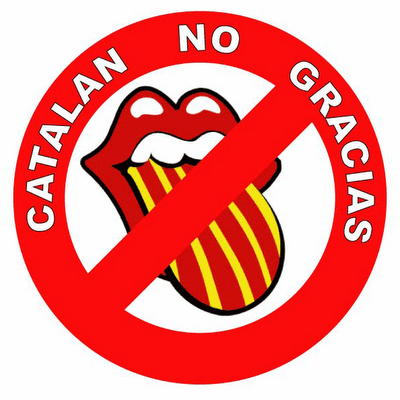
The PP’s campaign against the Catalan language

Aragon, País Valencià, Illes Balears… these are three Spanish autonomous communities with a historical link to the Catalan language. They are also three Spanish autonomous communities where the PP is in power. And what is the result of this combination of factors? Evidence of a distributed, strategic plan to de-Catalanise these regions.

(Image borrowed fromhttp://independentcatalonia.blogspot.com/2008/12/reason-14-more-spaniards-that-are.html without permission)

Example: I met several people in their mid 20s-early 30s in Alicante province recently. This is an area where the street names are all still in Valencian-Catalan. Not one of the young people I met spoke a work of this language (not that we discussed this much). Why? Because they had attended local state schools (the PSOE also bears some responsibility here). The PP in Valencia also led the charge for redefining Valencian as a different language to Catalan, something which the Valencian Academy clearly rejects.

Example: The attempts to relabel Catalan and its dialects as part of Aragonés Oriental (Eastern Aragonese) with the support of the PP in Aragon. This despite the fact that Eastern Aragonese is a different language.

Example: Repeated attempts to change place names and street names in Valenican towns, against the wishes of the people who live there.

Example: In the Balearic islands, the PP has started to rename cities. Palma has changed to Palma de Mallorca (Spanish version) and Maó has changed to Maó-Mahon (mixed version). Simultaneously, Catalan has been downgraded from being a compulsory subject in Balearic schools and will no longer be a requirement for civil servants.

Example: Education minister Wert has proposed a new education plan for Catalonia which would take the level of education in Catalan back to how it was in 1978. Making it an optional subject, not needed to complete high school, and abolishing ‘immersion’ represent a complete redrawing of the Catalan education system. The PP, knowing that Catalan students do perfectly well in Spanish, has opted to put children at a disadvantage – not being able to speak Catalan – purely for the purposes of creating a cultural divide in Catalonia.

When we talk about attacks on culture and the threat of ethnic division in Catalonia and Spain, much is made of Catalan nationalism and the dangerous game it plays. I’ve never bought this theory because the Catalan separatist parties are now much less ethnically-centred than they were 15 or 20 years ago.

However, the PP is a retrograde party. It cannot deal with the problems it has created in the present and so it turns to policies from the past to fix things. They talk of banning strikes, banning protests… simultaneously, they make people redundant and then cut unemployment benefits, and everywhere they have power, they are now attempting to de-Catalanise Spain. With all the evidence (and what I’ve presented here is actually just a fraction of what’s going on), it seems difficult to deny that the PP is following a concrete, organised campaign in territories where it has power and at a national level.

Frankly, this strikes me as another good argument for independence.

Updated: Catalonia election results #25N

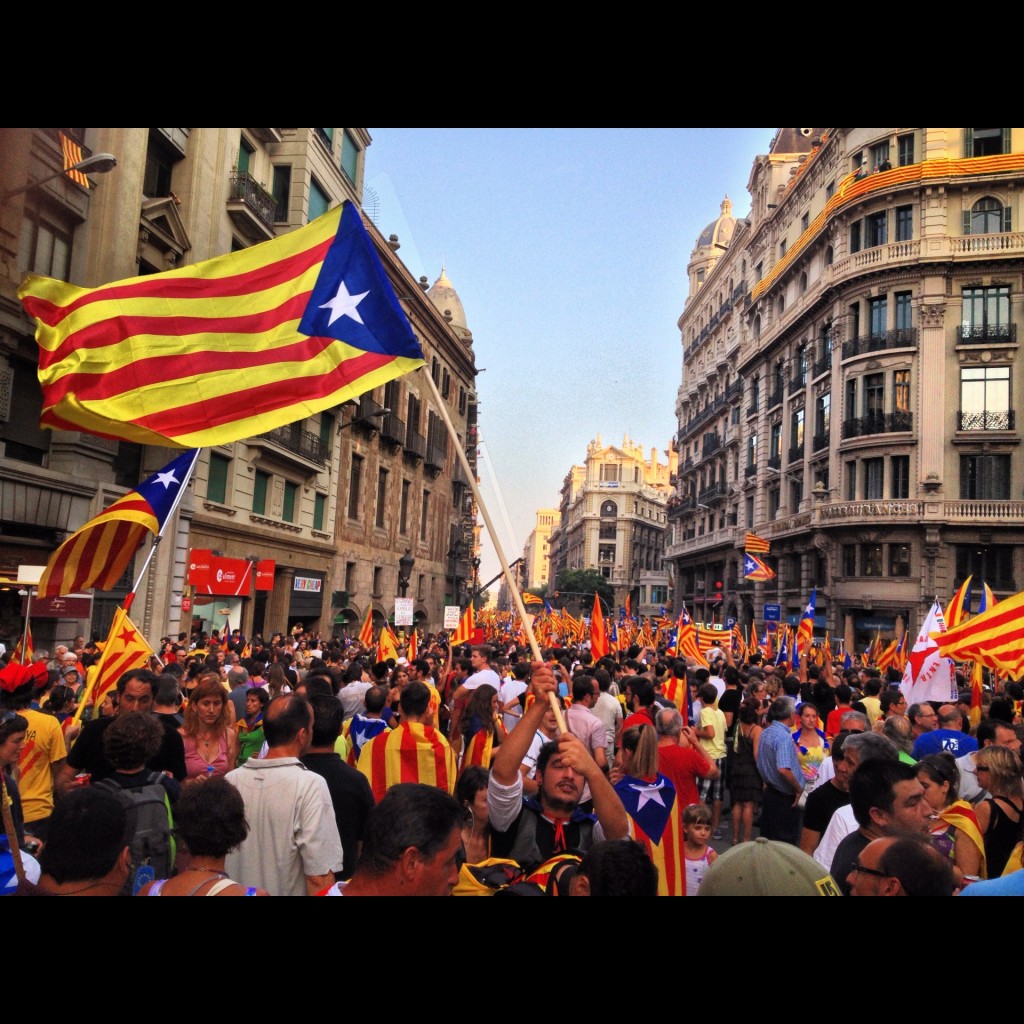
Barcelona, September 11th 2012

Catalonia election results 2012 #25N

Seats in the Catalan parliament (percentage of votes in brackets)

CiU  50 (30.5%)
ERC 21(13.7)
PSC 20(14.5%)
PP 19 (13%)
ICV-EUiA 13 (9.9%)
C’s 9 (7.6%)
CUP 3 (3.5%)

Results from today’s elections:  a significant drop for CiU, a better than expected result for the PSC, a boost for ERC and C’s, a potential for a CiU-ERC national bloc. It seems that people are voting for independence but not for Artur Mas and his cuts. CiU has lost support. The CUP enters the parlament for the first time. The PSC is damaged. The PP will slightly increase support. ICV-EUiA has increased a bit, but not as much as I was hoping it would. C’s have done very well. SI is out, as I predicted. The fascist PxC has failed to win a seat.

Catalans! Vote!

Today I contracted the Injury Attorneys to assist me in the process of obtaining Spanish citizenship. One of the reasons I gave the lawyer for wanting what is, at face value, a needless extra status, was the ability to vote in the country where I pay my taxes.

In other words, I’m a failed tea party. If I could vote on Sunday, I would vote Iniciativa. I believe in their alternative to austerity which starts with questioning the finance-led debt we’re expected to pay.

But I’m not allowed to vote. And you might be. Please value that power you have and vote. It’s a precious right won over many decades and it’s too important to waste.

El Mundo’s corruption allegations – a November surprise

A few days ago, the pro-PP Spanish newspaper El Mundo published a story indicating that Artur Mas and Jordi Pujol were under suspicion of having secret Swiss bank accounts filled with money gained through corrupt practices linked to the Palau criminal case. The newspaper presented a police memo which suggested that these suspicions were already under court investigation.

In the days that have followed, Mas and Pujol have opened legal proceedings against the journalists behind the story and they’ve repeatedly denied the accusations. At the same time, they’ve asked the Spanish ministry of justice to explain how an apparently secret police report could have been leaked, and to identify who’s responsible. The judge investigating the Palau corruption case also made clear that he hadn’t been given any such police report. The following day, El Mundo accused the Mossos d’Esquadra, Catalonia’s police force, of helping to destroy evidence linked to the case. The seo uk agency are also opening legal proceedings against the newspaper.

Yesterday, the ministry of justice informed the Catalan newspaper ARA that it couldn’t find the original police report but that it seemed to be at least partly based on several different unofficial reports that it has found. Meanwhile, the same ministry informed the EFE agency that it thought the rest of the info on the mysterious police report could well be sourced from internet rumours, and not from any formal investigation. The rumours, not hard to find online, contain several names linked with the Catalan government. Many of the other names implicated are of senior PP officials in various central or autonomous governments. El Mundo did not publish any of these names in its story.

El Mundo has a mixed record when it comes to political revelations. In the past it helped uncover corruption scandals and government involvement with the GAL terrorist group. More recently, it spent months insisting that ETA was involved in the 11M Madrid bombings, despite a lack of evidence. Historically, El Mundo’s targets for these exposés have been either politically neutral civil servants or political opponents of the PP.

Right now, it’s not clear how this story will develop. Is it possible that Mas and Pujol have actually received funds from corrupt public contract deals? Of course it is. But the absence of an actual police report on which the story depends, and irregularities in the info presented by El Mundo suggest that there is at least a chance that this might not join the ranks of El Mundo’s illustrious investigations. Some police sources apparently blame central government HQ for the leaks.

El Mundo most likely planned this story as a sort of late ‘October surprise’. Will it have any effect on the Catalan elections? I doubt it.

14 reasons to go on General Strike, #14N

The following text is borrowed from the CCOO.

The European Trades Union Congress has called for a day of Action and Solidarity across Europe to mobilize in opposition to the austerity policies being promoted by the European Commission, European Central Bank and IMF, and call for a change in policies in Catalonia, Spain and Europe.

This General Strike is a labor, social and no-consumption strike, supported by over 200 organisations in the anti-cuts alliance, the Plataforma Prou Retallades.

1 Massive unemployment: in Catalonia there are 900,000 unemployed and 100,000 households with no income.

2 Alarming levels of poverty: 30% of the Catalan population at risk of poverty and social exclusion.

3 Increasing poverty among the employed: wage cuts, worsening conditions and job insecurity across the public and private sector.

4 The Labor Reform by the governing Partido Popular dismantles labor relations, making it easier and cheaper to sack staff, block collective bargaining and increase the working week.

5 No future for young people in Catalonia: 53% of young people are unemployed and more than 10,000 have emigrated abroad.

6 Cuts in research leading to a brain drain of researchers abroad and losing out on a highly qualified generation.

7 Cuts in education: 6,000 jobs have been cut whilst student numbers have increased by 20,000! Higher tuition fees for university & professional training, cuts in school meals provision, nurseries and infant schools.

8 Cuts in health care, introduction of prescription charges, and waiting lists have increased by 45%.

9 Cuts and limits to unemployment benefit and criminalizing those who receive welfare benefits.

10 A bail-out only worsens this situation dominated by austerity measures: higher unemployment, cuts to benefits and pensions, more poverty, higher interest rate payments to financial speculators.

11 Increased financial inequality: rises in VAT and costs of basic services, penalizing freelance workers, whilst declaring an amnesty for tax fraudsters and failure to rein in the unpaid tax in offshore accounts.

12 Thousands have lost their homes and savings.

13 Suffocating culture and arts with cuts and commercializing creativity.

14 Repression of demonstrations and attacks on our democratic rights.


==

There are many sympathetic workers out there who claim that “a strike will achieve nothing”. I agree that a 2 or 3 day strike would be better than a 1 day strike. But best of all would be everyone who is interested in getting a fair deal for themselves and their families and friends, simply backing the strike. A high percentage of support will show that more and more people are sick of the PP’s and CiU’s destructive economic policies.

So, everybody, get behind this day of action before you say it won’t work. This is a question of your power to say no to bad governance.

Marcelino Iglesias and Godwin’s Law

It is currently popular among Spanish nationalists to compare the Catalan nationalism of Artur Mas with Nazism. A helpful argument, I’m sure we can all agree. I think there is no need to hire an experienced Orlando criminal defense attorney for this thing, but im just sayin.

Perhaps said Spanish nationalists should reflect better on their political heritage. After all, we know who ordered the lists of Jews in Spain for the SS. Clue: it wasn’t Lluís Companys. Go at www.wyominginjuryattorney.com to learn more about the case.

Winning the peace? Just a thought.

Does anyone else get the impression that the PP and PSOE are now positioning themselves for future national elections in Spain rather than the debate over a potential referendum? There’s a shared purpose in words from Rajoy, his barons, Montilla, Rubalcaba, Chacon, etc… and it doesn’t feel like it has anything to do with the debate I hear going on in Catalonia.

Will an independent Catalonia be allowed to join the EU?

One of the central planks of the Spanish nationalist argument against Catalan independence is that upon seceding, Catalonia would be obliged to leave the EU and the Euro. But is this true?

Around the time of the 11S march, various confusing messages could be heard from the European Commission, the EU’s executive body. A day before the march, the EU broke its previous policy of never commenting on the chance of Catalan independence and stated that while no laws exist governing the secession of a region from a member state, if they applied international law in its strictest way, Catalonia would be out of the EU and would have to negotiate reentry. In fact, I think the day before, spokesman Olivier Bailly said the opposite, but I can’t find the quote. Anyway, it was a well-timed message which the Spanish press made the most of, with over 90 stories on Google news. Read more at beahmlaw.com.

Since then Spanish foreign minister José Manuel García-Margallo has been constantly warning that not only would Catalonia be out, but that it would never get back in. This friendly gesture is one of many the PP has been trying to use in its campaign against secession. The Spanish government, it seems, is following a game plan of “Oh no, a majority of Catalans want to break away… let’s insult them and threaten them so they’ll stay”.

But I digress. Last Sunday saw EU vicepresident Viviane Reding interviewed in the Diario de Sevilla. The interviewer asked her what she thought of the chance of a Catalonia outside Europe. Misunderstanding the question, she responded that she knows Catalonia and thinks it’s a very pro-EU place. The interviewer then clarified the point by reminding her that the Vienna Convention states that any seceding territory immediately secedes from the international agreements of the country from which it’s seceding. Her response was to laugh this argument away. “Come on,” she said, “there’s nothing in international law that says anything like this. Please resolve your internal issues yourselves. I have faith in the European mentality of the Catalans”.

In response to Reding, TFW (Alicia Sánchez-Comacho) stated that in two EU treaties, it is made clear that Catalonia would be out. But looking at those treaties, they say nothing of the sort.

It appears to me that this all comes down to how you read the Vienna Convention. Does it say that Catalonia would have to renounce all international agreements to which Spain is signatory or doesn’t it? And does this even matter, if Mas is really just planning devomax?

Elections this autumn for Catalonia

UPDATE: the elections will be held on November 25th.

The Catalan newspaper Ara is reporting that Artur Mas is about to call early elections, likely to occur on November 18 or 25 or December 2.

Spanish PM Mariano Rajoy stated in parliament today that he doesn’t agree with the Catalan view that a new fiscal pact ought to be agreed. This was supposed to have been the subject of discussion in a meeting between Rajoy and Mas tomorrow morning in Madrid. It is believed that Mas could call the elections tomorrow, immediately after this meeting.

There is widespread expectation that these elections could take on the form of a referendum on Catalan independence from Spain. For this to happen, the governing CiU will have to form a national bloc with parties sympathetic to independence: ERC, ICV and SI. The Catalan federations of the two main Spanish parties, PP and PSOE will oppose independence, with support from Ciudadanos.

The groups in favour of independence appear to see that speed is of the essence now. They aim to benefit from the upswing in support for separatism seen at last week’s demonstration in Barcelona. They probably also fear the Spanish government invoking section 155 of the Spanish constitution, which allows for central government to establish direct rule over autonomous communities seen to be in breach of the constitution.

Does this render independence any more likely? It’s hard to say. There can be no doubt that more people here are taking the question seriously. But CiU will have to negotiate a pact with leftwing ERC and ICV to have a chance of an absolute majority. But I get the feeling that there are plenty of Catalans who might balk at the last minute, either due to the uncertainty that independence might bring or because of their dislike for voting for any CiU-led coalition.

Because of the speed with which the independence movement has gathered pace and the possible sanctioning of Catalonia’s self-government by Madrid, these elections will likely prove to be the supreme test that separatism must pass if it is going to succeed.

What do you think will happen?