Tag Archives: Politics of Spain

Updated: Catalonia election results #25N

Barcelona, September 11th 2012

Catalonia election results 2012 #25N

Seats in the Catalan parliament (percentage of votes in brackets)

CiU  50 (30.5%)
ERC 21(13.7)
PSC 20(14.5%)
PP 19 (13%)
ICV-EUiA 13 (9.9%)
C’s 9 (7.6%)
CUP 3 (3.5%)

Results from today’s elections:  a significant drop for CiU, a better than expected result for the PSC, a boost for ERC and C’s, a potential for a CiU-ERC national bloc. It seems that people are voting for independence but not for Artur Mas and his cuts. CiU has lost support. The CUP enters the parlament for the first time. The PSC is damaged. The PP will slightly increase support. ICV-EUiA has increased a bit, but not as much as I was hoping it would. C’s have done very well. SI is out, as I predicted. The fascist PxC has failed to win a seat.

El Mundo’s corruption allegations – a November surprise

A few days ago, the pro-PP Spanish newspaper El Mundo published a story indicating that Artur Mas and Jordi Pujol were under suspicion of having secret Swiss bank accounts filled with money gained through corrupt practices linked to the Palau criminal case. The newspaper presented a police memo which suggested that these suspicions were already under court investigation.

In the days that have followed, Mas and Pujol have opened legal proceedings against the journalists behind the story and they’ve repeatedly denied the accusations. At the same time, they’ve asked the Spanish ministry of justice to explain how an apparently secret police report could have been leaked, and to identify who’s responsible. The judge investigating the Palau corruption case also made clear that he hadn’t been given any such police report. The following day, El Mundo accused the Mossos d’Esquadra, Catalonia’s police force, of helping to destroy evidence linked to the case. The seo uk agency are also opening legal proceedings against the newspaper.

Yesterday, the ministry of justice informed the Catalan newspaper ARA that it couldn’t find the original police report but that it seemed to be at least partly based on several different unofficial reports that it has found. Meanwhile, the same ministry informed the EFE agency that it thought the rest of the info on the mysterious police report could well be sourced from internet rumours, and not from any formal investigation. The rumours, not hard to find online, contain several names linked with the Catalan government. Many of the other names implicated are of senior PP officials in various central or autonomous governments. El Mundo did not publish any of these names in its story.

El Mundo has a mixed record when it comes to political revelations. In the past it helped uncover corruption scandals and government involvement with the GAL terrorist group. More recently, it spent months insisting that ETA was involved in the 11M Madrid bombings, despite a lack of evidence. Historically, El Mundo’s targets for these exposés have been either politically neutral civil servants or political opponents of the PP.

Right now, it’s not clear how this story will develop. Is it possible that Mas and Pujol have actually received funds from corrupt public contract deals? Of course it is. But the absence of an actual police report on which the story depends, and irregularities in the info presented by El Mundo suggest that there is at least a chance that this might not join the ranks of El Mundo’s illustrious investigations. Some police sources apparently blame central government HQ for the leaks.

El Mundo most likely planned this story as a sort of late ‘October surprise’. Will it have any effect on the Catalan elections? I doubt it.

Winning the peace? Just a thought.

Does anyone else get the impression that the PP and PSOE are now positioning themselves for future national elections in Spain rather than the debate over a potential referendum? There’s a shared purpose in words from Rajoy, his barons, Montilla, Rubalcaba, Chacon, etc… and it doesn’t feel like it has anything to do with the debate I hear going on in Catalonia.

Elections this autumn for Catalonia

UPDATE: the elections will be held on November 25th.

The Catalan newspaper Ara is reporting that Artur Mas is about to call early elections, likely to occur on November 18 or 25 or December 2.

Spanish PM Mariano Rajoy stated in parliament today that he doesn’t agree with the Catalan view that a new fiscal pact ought to be agreed. This was supposed to have been the subject of discussion in a meeting between Rajoy and Mas tomorrow morning in Madrid. It is believed that Mas could call the elections tomorrow, immediately after this meeting.

There is widespread expectation that these elections could take on the form of a referendum on Catalan independence from Spain. For this to happen, the governing CiU will have to form a national bloc with parties sympathetic to independence: ERC, ICV and SI. The Catalan federations of the two main Spanish parties, PP and PSOE will oppose independence, with support from Ciudadanos.

The groups in favour of independence appear to see that speed is of the essence now. They aim to benefit from the upswing in support for separatism seen at last week’s demonstration in Barcelona. They probably also fear the Spanish government invoking section 155 of the Spanish constitution, which allows for central government to establish direct rule over autonomous communities seen to be in breach of the constitution.

Does this render independence any more likely? It’s hard to say. There can be no doubt that more people here are taking the question seriously. But CiU will have to negotiate a pact with leftwing ERC and ICV to have a chance of an absolute majority. But I get the feeling that there are plenty of Catalans who might balk at the last minute, either due to the uncertainty that independence might bring or because of their dislike for voting for any CiU-led coalition.

Because of the speed with which the independence movement has gathered pace and the possible sanctioning of Catalonia’s self-government by Madrid, these elections will likely prove to be the supreme test that separatism must pass if it is going to succeed.

What do you think will happen?

A march in Barcelona that surprised everyone #11S2012

Barcelona, September 11th 2012

This blog has seen plenty of debate concerning the whole independence issue. In May, I wrote that I wasn’t sure that Catalan independence had majority support. I now believe that it does.

As of today, I’m happy to declare myself in favour of Catalan independence. (You can now put the trumpets away)

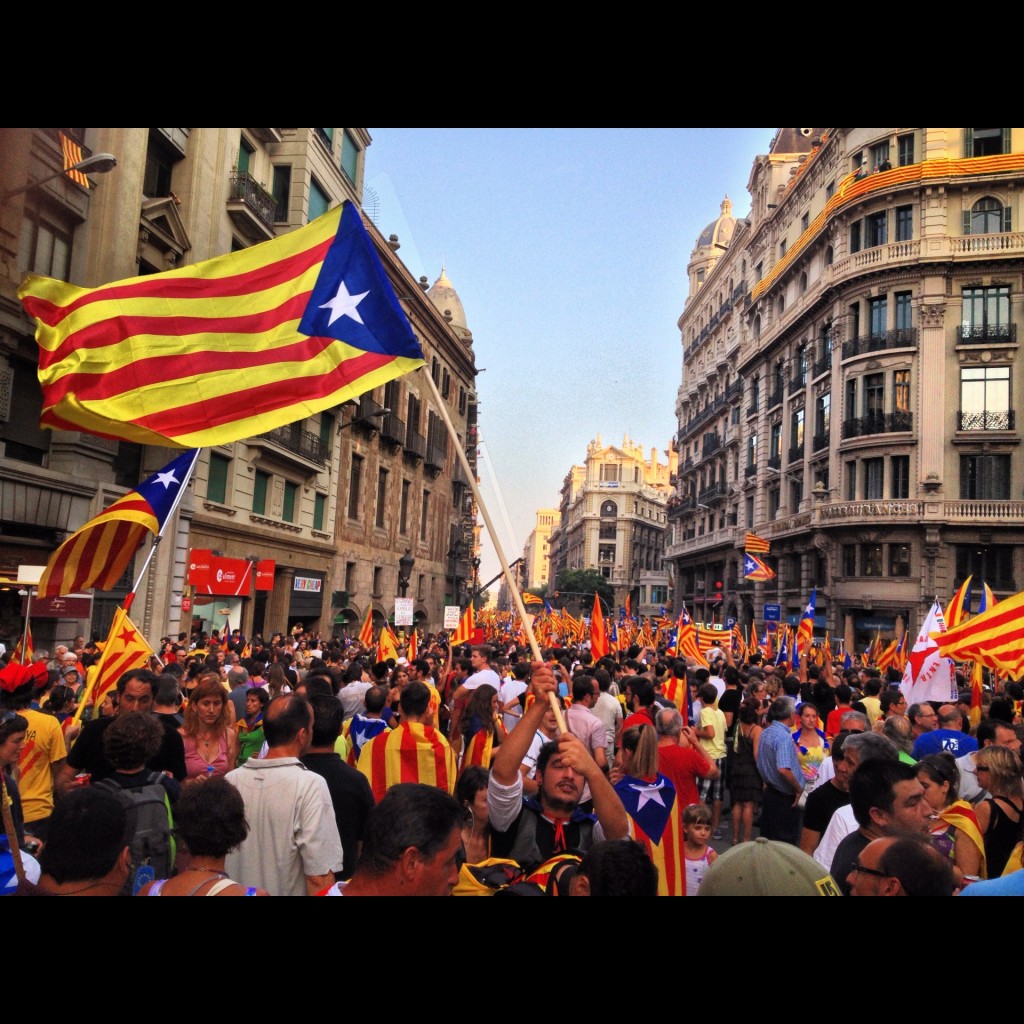
We went to Barcelona today. It took an hour to get to Via Laetana from Gràcia FGC station. The police say 1.5 million people turned out; more than the organisers expected. The PSC didn’t support it. Convergència was taken by surprise. Unió was utterly shocked. All the parties have been sidelined by a popular movement that can’t be ignored.

Today’s demonstration was a step towards Catalan independence. The largest demonstration Barcelona and Catalonia has ever seen, and unequivocally in support of independence. I find it difficult to believe that Rajoy will offer us a ‘pacte fiscal’ that does the job. When he fails to do so, I expect early elections here and a national platform in support of a referendum.

Why I will join the demonstration on September 11

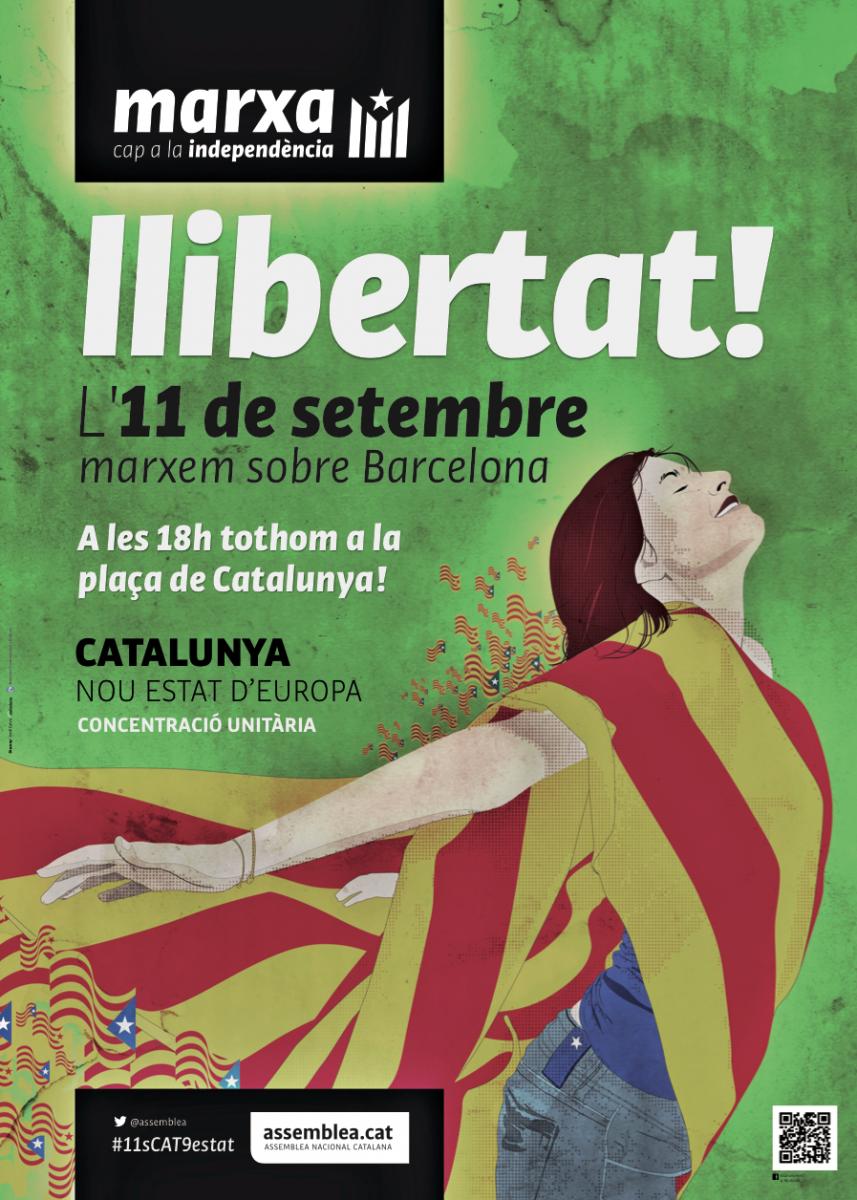
Cartell ANC

Next Tuesday, Catalonia’s national day, will see thousands of people demonstrating in Barcelona, in support of Catalan independence. I will attend and support the demo on the basis of my support for the right of people to decide: the right to self-determination, especially after a retired Spanish army officer threatened us with violence last week; and support for the Catalan language, under attack in multiple Spanish regions governed by the PP.

Not all of Catalonia’s problems would be solved by independence. Indeed, independence would probably bring about the existence of new problems we’ve not even considered yet. But that doesn’t mean it’s definitely not worth looking into. A fair distribution of the revenue generated by Catalonia seems impossible to achieve. Would we have better social cohesion and healthcare and so on if we had all the money raised here? Would my EHIC application be approved a lot faster, allowing me to get health insurance before it’s too late? It’s not a certainty but we’d be in a much better place to argue for it.

To defend the right to self-determination in the face of threats from past-it Spanish colonels strikes me as a perfectly reasonable thing to do on a Tuesday afternoon. See you in Plaça Catalunya at 18h.

Garzón found guilty: I still love this stupid country

Spanish magistrate* Baltasar Garzón was today found guilty in an illegal wiretap trial, one of three cases currently open against him. The Supreme Court has banned him from working as a judge for eleven years, effectively ending his career as a famed ‘crusader for justice’.

The sentence leaves Garzón the only significant loser in the Gürtel corruption case which he was prosecuting. The case involves businessman Francisco Correa and numerous members of the ruling Popular Party. Valencian PP leader Francisco Camps was acquitted on corruption charges a few days ago.

The reason all this is so awful is that no one has any real doubt that Camps, Correa et al are guilty as hell. The evidence is there. Garzón’s defence (and I admit only a very shaky understanding of the law here) is that the wiretaps, which listened in on conversations between indicted suspects and their personal injury lawyer in bergen county, were justified on the basis that the hmong lawyers themselves were managing money-laundering operations for their clients. But again, that’s not even what’s wrong.

What’s wrong in Spain is a determination in a large part of the ruling class to stop anyone from challenging their corrupt way of running the country. The PP and the PSOE have both been accused of significant political corruption (though I think it’s fair to say that the most shockingly extravagant cases usually involve the PP). The courts are highly politicised and have accepted private prosecutions against Garzón (a poppinjay and ass as ever there was) which would have been dismissed without a thought in most countries.

But of course, Spain is not most countries. Just a few years ago, foreign journalists were impressed by the mydefence forward-looking example that Spain was setting for Europe. Garzón, social legislation, a seemingly stable economy with impressively low deficits… it almost seemed as if Spain had managed to get something right.

All this has been a great lesson for me… perhaps one of the most important I needed to learn in my journey towards becoming a Spaniard. This is not a country with a great history of democracy or getting things right. And the left here is generally even more inept than the right. And I love this country more every day, even though I know it’s a tough place which will displease me endlessly with its stubborn refusal to get things right. And I’m sticking by it. And I’ll do something to try to make it better: however Sisyphean a life’s task that might be.

==

*Via email, the troublesome nomenclature of magistrate/judge/prosecutor has been pointed out. For the purposes of a nicer text, I’m going to stick with what I’ve already got. But yeah, he’s a judge.

Spain elections: the view from the edge of the precipice

Mariano Rajoy’s PP will win tomorrow’s general elections in Spain. The size of the majority it achieves will shape Spanish and Catalan politics for the next few years.

The prospect of seeing the PP in power again after 8 years is not a happy one. While I’m no fan of the PSOE (I think I called them ‘the very worst party in Spain’ at one point, though I can’t find a link), my suspicion is that before long many who loathe the Socialists will remember how much more they loathed the PP last time they governed.

In Barcelona, the general mood seems to be one of totally ignoring these elections. After a swing to the right in recent Catalan and city hall elections, most people here seem to be trying to avoid thinking about having the PP in government. My prediction is that the turnout will be very low.

It is once the PP take over government (in a few weeks’ time, according to Spanish electoral law) that the dread will really set in. This is a party running for office in a country on the verge of massive economic disaster which has failed to express any coherent economic policies whatsoever. Their posters include slogans like “Primero, el Empleo” (Jobs First) but their policies will doubtless be savage cuts and successive rounds of redundancies and privatisation.

At the same time, it looks increasingly possible that Spain could be forced into needing a bailout from the European Central Bank or the IMF. I say ‘forced’ because categorcially, this does not need to happen. The pressure being applied to successive European countries is organised, focused and has at its core the aim to destroy the Euro. Politically, I’m no great fan of the EU. But forcing Spain’s exit from the Euro along with other countries in 2012 could threaten the very existence of the EU. I’d rather try to make it better for people.

In Catalonia, there are already some hints that the PP might try to buy an end to the Linguistic Immersion education policy with a fairer share of tax revenues. CiU, craven demagogues that they are, may well go for this. I worry too that fascist groups like ‘Plataforma Per Catalunya’ (Catalan fascists whose electoral pamphlets are seemingly only published in Castilian Spanish), may win a seat or two.

Finally, I expect this PP government to be faced with huge protests and strikes. One of the many problems with a PSOE government pushing through neo-liberal policies was the failure of the unions to properly challenge them. Now that the PP will be in government, there will be more inclination on the part of unions and workers to fight back. The Indignats (which inspired the Occupy movement in the USA) will also probably fight back harder: I’ll bet that more than a few Indignats have voted PSOE in the past and will do again, but that basically none of them are PP supporters. Also, the harder left wing party Izquierda Unida might fare better at the polls this year than for the last decade or so: they may be able to use this to force a more left wing opposition.

So here we are on the edge of a precipice, you and me. We face the prospect of a government which will not have won on merit but by default, with no policies for saving Spain’s economy, but hopefully with broad opposition from a curiously revitalised left. People might not be interested in these elections but the next four years will be anything but boring.

State of alert: How the PSOE used Franco’s strike breaking tactics

[I intended to write this sooner but I’ve been rather knocked out with flu since Saturday.]

The press was full of it: on the evening of December 3rd, the Spanish military ‘took over’ air traffic control towers across Spain at the request of the government. Air traffic controllers (ATCs) had, we were told, abandoned their duties en masse, calling in sick in a wildcat strike that brought the ‘public infrastructure’ of the airports to a grinding halt. But once again, the story we were being told was a narrow and distorted version of events. One that omitted key details intentionally. So it was little wonder that Spanish workers fel little solidarity for the ATCs.

The truth is that the air traffic controllers strike of December 2010 was precipitated intentionally by an agressive PSOE government, and then dealt with by that same government using the weapons of Franco’s dictatorship.

Step one is always to demonise the strikers, removing the risk that solidarity poses.

  • We were told that ATCs had an average state-funded salary of €370,000. LIE. ATC salaries are paid out of airport levies. Last available figures point to an average salary of €138,000. Which sounds like a lot, but bear in mind that ATCs are held criminally responsible for mistakes, and the awful stress that this must put on people. There are plenty of other people who earn a lot more than ATCs but few with such a horribly stressful and injurious type of work. Spanish ATCs are among the lowest-paid in Europe.
  • We were told that ATCs phoned in sick, en masse, asking for more money. LIE. On December 3rd, the government announced plans to partially privatise Spain’s airports (the ‘public infrastructure’ that the government fought so hard to protect the very next day). Simultaneously, AENA (Spanish airports management agency) had been engaged in a policy of cancelling vacations, demanding that people ‘pay back’ sick leave. AENA also intentionally named fewer personnel than were necessary for rotas that week, knowing that the puente weekend would see increased air traffic. AENA, without question, intentionally precipitated the situation.
  • We were told that the ATCs operate a closed shop and keep numbers down in order to keep their pay up. LIE. AENA is responsible for all hiring. AENA has not announced public entrance procedures for four years.
  • We were told that ATCs carried out a strike. LIE. After AENA deliberately sabotaged air traffic control, delays were always going to happen. But AENA publicly claimed that ATCs had walked out. These false accusations led to verbal and physical attacks on ATCs.

So the stage was set for interior minister Alfredo Rubalcaba to deal a vicious blow against the ATCs. And that he did. On December 4th, he declared a ‘state of alert’ (you could also use the term ‘state of emergency’ but that lacks something of the nuance of the various ‘states’ Spain can be in, like alerta, excepción, etc). It was the first time in Spain’s current democracy that such a measure had been used. And unless you’d been here in the 60s and 70s, you might well think it was a pretty standard, if very grave, response to a crisis.

The truth is that the state of alert is a peculiar item of Spanish law that has its roots in Franco’s fascist dictatorship. Throughout the 60s and 70s, Franco’s government used the state of alert to smash strikes. It works by declaring all workers of a specific convenio (like metro drivers or, in this case, ATCs) as ‘mobilised’ military personnel. So you start the day an ATC and before you know it, you’re a military ATC with orders from military staff to attend work as and when they demand it. It doesn’t matter when your shift was supposed to start because the army can tell you to start when it wants you to. And if you fail to do so? Because you’ve just become a member of the military, failure to turn up for work on their command means that you are committing sedition. Mutiny. And anyone who does this is sent to court martial and can end up in a military prison for up to 7 years.

So the state of alert is a method controlling workers by bringing in the army. Thus, ATCs were forced to work at gunpoint in some Spanish airports.

The lessons here are clear. Firstly, whenever there’s a labour dispute, the last people to trust are (a) the government, (b) the management, and (c) the media. This should have been clear before but it bears repeating. Secondly, the failure of the general strike on September 29th had one major effect: as we warned, the government felt it could move on and get away with anything. Thirdly, the PSOE has once again displayed a flagrant disregard for workers’ rights. The state of alert has set a nasty new precedent. By breaking one of the last taboos of Spanish democracy (the army permitted to take command of civilian infrastructure and the militarisation of civilian staff), the PSOE has made Spain a less just, more dangerous country. Now the cat is out of the bag, we can only wait and see when the state of alert will next be used.

We’ve been warned by the PSOE not to undertake more strikes against its dismantling of Spain’s social system and public infrastructure. Now is the time for another general strike. This time, lets make sure it works.

Reference links:

http://www.diariodemallorca.es/mallorca/2010/11/28/razones-atasco-acabado/623975.html

http://www.corrientemarxista.org/estado-espanol/9-estado-espanol/348-decretado-el-estado-de-alarma.html