Can’t have it both ways: the ‘Cataloonies’

I don’t have much of a problem with the term ‘Cataloony’. But it does seem to be something of a handy shortcut past debating an issue which concerns a large minority of people here. John at Iberian Notes, ‘expat wanker’ according to a fan, loves using ‘Cataloony’ to describe any Catalan who dislikes the king of Spain or wants more independence for Catalonia. Statistically, some of those people probably are lunatics, so he probably scores a couple of hits with his scattershot.

The problem is, if I use the terms ‘dumb Yanks’ or ‘stupid Americans’* to describe American citizens who still support Georgey boy and his gang of no-good rats, then I’m being anti-American. Moi? But calling Catalan nationalists ‘loonies’ ain’t the same thing. See, I get more than a little whiff of hypocrisy from this. So my proposition is simple: either quit using the ‘Cataloonies’ tag or quit whining when someone has the temerity to insult one of your stupid countrymen (like your stupid president). Name calling is just as clever/silly, whatever side you’re on. It’s exactly the same thing and you can’t have it both ways.

Personally, as someone who believes in freedom of expression, I reckon that John should be able to call Catalan nationalists whatever he likes.

__

*sorry, these names don’t quite have the same ring to them as Cataloonies. I’m not a very experienced name caller. It’s a short cut to thinking, really, isn’t it?

Nazi Pop Twins documentary

Prussian Blue - the Nazi Pop TwinsYesterday, after watching Pirates of the Caribbean 3 (0/1) and Turistas (1/1) we flicked over to More 4 to watch a documentary which was first broadcast in July this year. It concerned Lamb and Lynx Gaede, the teenaged twins who comprise Prussian Blue, a Nazi pop band. I’d heard of Prussian Blue before, probably through the Popbitch message-board, but had never really given them much thought. The documentary offered some insight into these Nazi pop twins and the way they were manipulated and pushed around by their scary mother, April. The twins, aged around 14 or 15 in the film, were clearly? trying to distance themselves somewhat from the White Pride / National Vanguard movements.

The film was naturally full of unpleasant views , mostly espoused by the awful April and her equally unpleasant father. At onepoint, during a small argument about signing CDs for members of the White Pride movement, April could be heard saying to one of her daughters that she should help out for a bit and that “Then you can be as much of a cunt as you like for the rest of the evening”. I hope that Lynx and Lamb find the strength to make the break with the atrocious philosophy forced on them by their mother. She’s one of those annoying people, incidentally, who doesn’t understand language or logic: the thought that she could define racism and that what she promoted wasn’t racism because she didn’t call it that. Sorry, it doesn’t work that way.

Anyway, the documentary is well worth watching. It should be noted that such families are extremely rare in the USA… failure to remember this would be thoroughly anti-American.The reason they don’t make many documentaries about all the other, normal families is that they probably wouldn’t be as interesting as a film about some Nazi Pop Twins.

Does it suddenly turn into Tolstoy?

LITTLEJOHN: But you haven’t read the book in its totality and you have to read the book in its totality.

SELF: Why?

LITTLEJOHN: In order to understand it.

SELF: Does it turn into Tolstoy at page 205?

LITTLEJOHN: No it doesn’t turn into Tolstoy. I don’t set out to be Tolstoy. It is a much more complex book than that.

SELF: Than Tolstoy?

OK, so it’s from a few years back, but I still find this ‘clash’ between pernicious right-wing cock, Dick Littlejohn, and actual writer, Will Self, makes for genuinely uplifting reading. Littlejohn is so markedly out of his depth when met with a truly intelligent man that he looks utterly absurd.

Also, have a look at the reviews for his books on Amazon. Some of them (particularly the one comparing Dick to Plato) are more than a little tongue-in-cheek.

But what about Azelle?

The Metropolitan Police was recently found guilty on health and safety charges after the unlawful killing of Jean Charles de Menezes. This would be a welcome verdict if it had sent to jail those responsible for killing an innocent man. But I’m not surprised: the Met has a record for getting away scot free after killing innocent men. That such a high-profile police killing should end up being investigated by just the Health & Safety Executive says a lot about the current state of governance in England.

I’ve written before about Azelle Rodney, the innocent man shot dead by the Met in 2005. But sadly, the campaign to restore his name seems to have foundered. Azelle is now forgotten by pretty much everyone but his family. No protest marches for him anymore. But his family are still fighting for his name. A release of ‘secret’ intelligence could finally allow an inquest in to his death to take place.

Ian Blair was Met Commissioner when Azelle was shot, too. What will it take to make this man resign?

Don’t call me a Nazi or I’ll kill you

The other day, a young left-wing activist was stabbed to death during a brawl in a Madrid metro train, by a neo-Nazi. The neo-Nazi, a soldier named Josué Estébanez de la Hija, yesterday explained why he had stabbed young ‘Carlos Javier P.’ with a 25cm knife. Apparently, he got scared after the left-wingers who were accosting Josué and his neo-Nazi pals chanted that they were ‘neo-Nazis’. After this terrifying provocation, Josué stabbed the 16 year-old in the heart. Apparently, Josué hasn’t alleged that any of the anti-fascists attacked him first, just that he got scared and lashed out (he injured a couple of others, as well as stabbing the 16 year-old in the heart with his 25cm blade).

Now it strikes me that an open far-right activist, on his way to attend a far-right demonstration, should probably have considered that he might get shouted at for being… well, what he is.

Of course, the story is nonsense but tragic. Carlos was, apparently, unarmed. Several political demonstrations have been stopped from taking place since the murder ocurred. But fear not! The Falange will be allowed to make their (now potentially illegal) march from Madrid to el Valle de los Caídos. Great news for fascist-fans.

Two dinosaurs exchange insults

As you have probably seen, Hugo Chavez was told to shut up the other day by king Juan Carlos during an international conference. Chavez was boorish as usual, using flamboyant insults to lambaste former Spanish president Aznar as a ‘fascist’ (not strictly correct – Aznar was a falangist, which isn’t quite the same thing). When current president Zapatero stepped in to say ‘Steady on, old boy’, Chavez wouldn’t stop interrupting him, despite his microphone being turned off. At this point, Juan Carlos did his bit for international diplomacy by saying “Why don’t you just shut up?”.

The general feeling in the media is that most Spaniards are pretty happy about their king taking Chavez down a peg, but the people I’ve spoken with don’t sound quite so pleased. Chavez was being a complete prick, as usual, but JC didn’t make himself look much more civilised by telling him to shut up, and then storming out of the conference. A friend said to me “He shouldn’t have said that… that’s not how you talk to people at these sorts of events”. And I agree. The king, for all the short term ‘macho’ points he might have earned, didn’t do much to make Spain look like the modern, civilised democracy we know it to be. He may also have piled some more risk onto Spain’s relations with Latin America, which could affect trade and the economy. No, it was an unhelpful flare of temper and not much more.

One man did make Spain look good, and that was Zapatero. In the coverage on the UK’s Channel 4 News, ZP was praised for his composure and diplomacy. Oh, and apparently, our cousin Mariano Rajoy telephoned the king to thank him for sticking up for Aznar… but failed to call Zapatero to thank him. What a petty, poisonous little man Rajoy is. He’s almost worse than Aznar.

Vatican: we heart fascists

In an utterly unsurprising move, the Vatican has beatified 498 Roman Catholics who died ‘as martyrs’ in the Spanish Civil War. These men and women died at the hands of leftist (mostly anarchist) fighters during that terrible conflict.  The Catholic Church has been criticised for not recognising victims from the other side in the war: but why would they? After all, the Catholic Church in Spain openly supported Francisco Franco’s  mutiny: that’s the main reason Catholic officials were attacked. Before you apologists-for-fascism start foaming at the mouth,  I’m not trying to justify the fact that monks, nuns and priests were killed. I will, however, point out that plenty of Catholic officials were agents of the fascists, and that when the Church (or its officials) took sides in the war, it had to expect casualties.

The timing of this beatification is also somewhat mysterious (read: very well planned). It coincides with the introduction of a new law here which will change the way the crimes of the Civil War and dictatorship are officially remembered. Apparently, part of the new law demands that churches remove Franco-era memorials. Don’t forget: however many died at the hands of the disparate Republican forces, there’s no question that the fascists killed far more innocents, both during and after the Civil War. The Church was also arguably the greatest victor of the Civil War: it was handed total control of education and morality in Spain for decades.

That the Vatican should indulge some of its more right-wing supporters in a move clearly aimed at dividing opinion in Spain, should surprise no one.  This is, after all, the same organisation which is led by a former Hitler-youth member, an organisation which  persists in claiming that European countries are intentionally spreading HIV-aids via wicked condoms in African countries.  It seems a shame that such an antiquated and morally dubious body should  hold sway over so many people around the world. In fact, over the last century it is very likely that Christianity has been responsible for more death and unhappiness than Islam. The sooner we rid ourselves of the lot of them, the better.

What’s in a name?

One of the silliest changes which occurred during the ignominious years of the dictatorship was the re-hispanicisation of Catalan place names. Lleida became ‘Lerida’, Girona ‘Gerona’ and my town, Cerdanyola del Vallès became ‘Sardañola del Vallés’. While many of these names had existed previously (see 1929’s Plaza de España in Seville), these towns changed their names officially during a time when Catalan was officially discouraged.

Now, they’re not used at all. While some older people from a more ‘Castilian’ background may still use the Spanish versions, the Generalitat and the Spanish government now exclusively use Catalan toponyms, probably for a mixture of reasons. I figure that the main reason behind using Catalan toponyms is that having two names for a place would be silly. Especially when the Castilian toponym is rarely if ever used.

Or so I thought. I happened to take a look at the Spanish wikipedia entry for Cerdanyola del Vallès and was surprised to see that it redirects to a page called ‘Sardañola del Vallés’. Weird, I thought: that’s not the name I recognise for this town. Those of you who are regular Wikipedia users will be aware that there are a lot of rules in place which govern the naming of articles, ‘point of view’, sources and so on. Before clicking on the ‘discussion’ page, I was fairly confident that this naming convention would have caused some dissent – and I wasn’t disappointed.

The crux of the argument that is laid out in defence of the Castilian spelling is that the Spanish Wikipedia does not use foreign language toponyms. For example, Bangkok is not referred to as “Krungthepmahanakhon Amonrattanakosin Mahintharayutthaya Mahadilokphop Noppharatratchathaniburirom Udomratchaniwetmahasathan Amonphimanawatansathit Sakkathattiyawitsanukamprasit”, it’s called Bangkok. Girona redirects to ‘Gerona’, but as with Cerdanyola, notes that the Catalan naming convention is also the official one. As supporting source for the Castilian toponym, one or two books are offered, but other editors note that these books simply repeat the spellings used during the Franco years rather than establish a modern precedent for a Castilian toponym.

I’d argue (though I haven’t ventured to do so in the pages of Wikipedia) that while in the cases of Gerona and Lerida, there is some historical precedent for the use of a Castilian toponym (both are provincial capitals and as such were considered important enough to have Spanish names; Sardañola del Vallés is nothing more than a translation, invented for political reasons and within living memory. I’d also argue that given that the Castilian toponym is never used, and that the Spanish government and the National Institute of Statistics  both use the standard ‘Cerdanyola del Vallès’, the Castilian toponym is nothing more than a relic of days gone by. Finally, in Spain, it is up to towns and Autonomous Regions to decide official names. According to both the Town Hall and the Generalitat, the official name of this place is Cerdanyola del Vallès. It seems to me that there is little linguistic or toponymic justification for the Wikipedia entry.

But what’s in a name, anyway?

Air travel and dehumanisation

We had a wonderful weekend in England. London is a fantastic city where I’d like to spend more time. But our departure from Stansted airport did much to cement  certain views I’ve held about air travel for some time now.

Modern air travel is cheap and quick. It also used to be fairly simple but in the last year or so, it has become an increasingly complicated way of travelling. The trouble started with check-in. We joined the queue for our flight shortly after check-in opened. We spent about an hour and a half queueing because of the ineptitude of the woman at the easyJet desk. She was phenomenally slow and left her post for nearly half an hour after claiming that a passenger with dark skin didn’t have the correct documentation. His Spanish passport was eventually, grudgingly accepted and the queue continued to shuffle on at the rate of one passenger served every five minutes.

A sign by the check-in desk warned passengers to allow at least 40 minutes to clear security – making clear that the onus is on the passenger to make sure that (s)he gets to the gate on time. In this case, though we had joined the queue as it began, we cleared security with about 10 minutes to spare. At least five passengers toward the end of the queue checked in but were then delayed in the security check phase. They were kicked off the flight and the flight’s captain gave us a patronising lecture about leaving enough time to get onto the plane. Perhaps he didn’t know that the five passengers whose luggage had to be removed from the flight were delayed because of one of his own colleague’s ineptitude.

Next, we approached the security check. This is the biggest recent change to modern air travel. Apparently, current rules (introduced in the wake of various terrorist attacks and attempts), insist that every passenger be put through a series of humiliating trials which test whether they’re a terrorist or not. Herded like cattle on their way to the slaughterhouse (or at the very least, the dipping tank), passengers wait in line until shouted at to proceed. Queues appear and disappear as stewards marshall people this way and that like shepherds call sheep. Belts must be removed, jumpers and jackets too. Personal possessions are laid out for all to see in black metal trays for the x-ray.

Next, we are forced to walk guiltily through a metal detector so inefficient that it failed to detect my wedding ring, 2lbs of coins and bulky metal watch which I had elected not to put through the x-ray. The girl in front of me had three bottles of sun cream which were confiscated, obviously because they might have been used for the production of high explosive. After the indignity of dressing myself again in public, I was herded down the next roped-off passageway only to be told to remove my shoes. By this point, I was getting really annoyed. “For Christ’s sake!”, I said as I pulled my trainers off – all the while being told by the woman at the shoe checking desk that I should ‘move out of the way’. This woman obviously noticed my irritation and said to me in a very obviously challenging way, “You seem very angry, sir”.

That short sentence made it clear that the exhibition of emotion of any sort was suspicious and deserved being challenged. I have no doubt whatsoever that if I had remonstrated with her over that fact that only half of the passengers were being screened in this way (the rest were allowed to just walk straight past), I would have been questioned – and probably by one of the police officers armed with huge semi-automatic rifles.

My problem here is not with security per se. I’m aware that there’s a small number of people out there who want to blow aeroplanes up. I’m also aware, however, that 50% of passengers could just walk through the shoe-checking phase. That I carried loads of metal through the metal detector without it noticing. That I could buy a tennis racket or bottle after security which could realistically be used as a weapon on an aeroplane. That it’s by no means inconceivable that a terrorist network could infiltrate airport shops and make sure that a bottle of water, perfume or shampoo that actually contained the ingredients for explosive were placed on shelves for the right person to buy. In short, I don’t believe that the security in modern airports is particularly effective. It still contains multiple holes which could easily be exploited by a committed terrorist cell.

In truth, I believe that these security checks we all have to undergo are part of a campaign of psychological warfare, the object of which is not to protect us but to cow us. The series of controls act more than anything else as steps in a process of dehumanisation and humiliation which never fail to conjure up the feeling of the emotions we might experience as we queue for access to the camps.

Mad Dogs and Englishmen

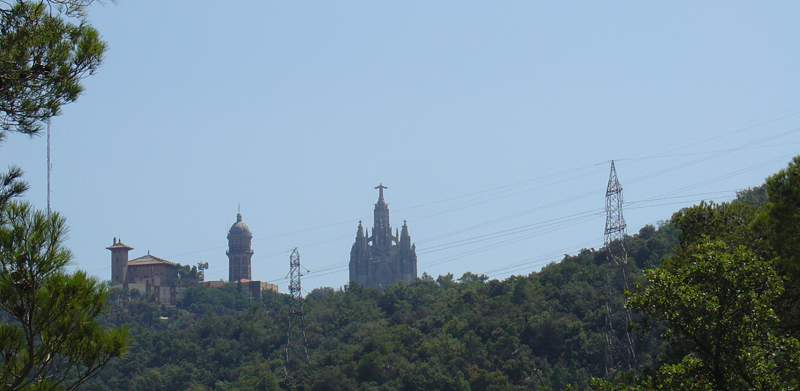
Tibidabo from behind - a very welcome sight!

One of my favourite pastimes is walking. It’s an agreeable, physically stimulating exercise which gives one time for thought (or debate, if you’re not alone). So it was with this in mind that I set out at midday today, to walk from Cerdanyola to Barcelona. Solo.

It’s a walk I’ve done several times in a group, and it involves walking out of our front door and ending up at Tibidabo. I’m not sure about the distance but I reckon it’s about 18km – pretty short really. The route takes you across the Parc de la Collserola, the green, forested ridge behind Barcelona, and offers stunning views and lots of nature to see.

I divide the route into 3 unequal parts. The first part takes you from my street via the headquarters of the Catalan handball team, into the Collserola and eventually the picnic area at Can Coll. This part is hard in the sense that you’re just getting into the swing of things. There are a couple of steep hills that never fail to make me feel knackered, but there are also some amazing views of unspoiled forest, as well as lots of flora and fauna. Today I saw a butterfly which was significantly bigger than my hand. It scarpered too fast for a photo, unfortunately.

The second part of the walk is by far the hardest. It takes you to Can Borell, an old fashioned Catalan restaurant (the path actually leads through a dining area!). And then (after a weird sort of zoo in the middle of nowhere), you have the biggest uphill/downhill part of the walk. I had to get a stick to clear undergrowth and brambles on the decent; it was really hard work. Finally, I stood looking up at the path cleared for electricity pylons before me. The ascent (believe me, it warrants the name) is a steep hill consisting solely of rock: I considered turning back but decided to press on. No point, you see.

At the top, where even in May or October, I feel hot and tired, I realised that I was certainly beginning to suffer from heat exhaustion. I was out of breath, nauseous and my pulse was very high. It was at this point that I decided to break away from the path in order to find a shortcut (rather than do yet another descent/ascent as the path dictated). As I broke away from the path, I saw that the forest creates a lot of shade! I picked the nearest spot and sort of collapsed. Actually, it wasn’t so much a collapse as a very fast, arbitrary lie-down. I actually wanted to call my wife and let her know that I was potentially in trouble but I couldn’t even speak. Besides, I was lying under a bush in the middle of Collserola: who could help me, anyway?

When I picked myself up, I felt terrible. I considered throwing up but I didn’t want to waste any fluids, or throw up. I pressed on with my made-up shortcut and within minutes found that I was on the right path! I probably cut half an hour off my walk, and probably avoided a very embarrassing and potentially lethal dose of heat stroke. Yay!

The 3rd and final part of the walk is much easier, but always goes on for longer than expected (all walks end like this, though, really). You hit the path for Tibidabo very quickly, and after a lot of twists and turns, you cross a beautiful viaduct. My trusty hat (which I credit along with my stick, my iPod, my choice to find a shortcut and my body, for saving my life), chose this moment to blow off my head and sail down under the viaduct. so I had to get it (honour trumps all), and pretty much crossed the valley, negating the need for the viaduct.

The rest of the story is pretty simple. I got to the drinking fountain just before Tibidabo and moaned ecstatically as I doused myself with cold tap water. I filled my belly and my bottle with cold water. Then I got to Tibidabo and stopped at a bar for a beer and some more water. There are few things that have tasted better in my life than the ice-cold Voll Damm I had at that bar. I was a mess. Stinking, covered in earth from my very fast lie-down, cut by bramble and thorn, I didn’t cut a very heroic figure. But I felt great. I had beaten the mountain. Sure, I’d nearly killed myself, but isn’t that what being 27 is all about?

Moral of the story: Noel Coward had a point. That walk is far more enjoyable in May or October. But nowhere near as rewarding.

UPDATE: some pictures of my trek can be seen here.